
This week’s Illustration Friday word is “déjà vu”.
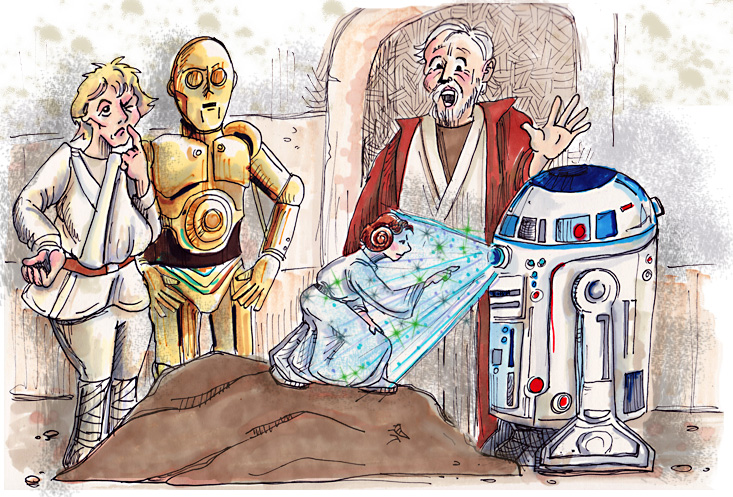
While the droid played the hidden message for the former Jedi Knight, Luke couldn’t help but feel that he had seen that girl somewhere before.
from my sketchbook: will the circle be unbroken

2010 came to a close last week, but it began almost 35 years ago, when I was in high school. After getting tossed out of the majority of my academic classes, I gravitated towards the art department. There, among those paint-splattered desks and rolls of brown kraft paper, I felt comfortable and had as much a sense of purpose as a 16 year-old could. It was in one of those art classrooms I met Eric Dorfman. My relationship with Eric could best be described as a cordial, but distrustful, rivalry. We weren’t so much friends as we “got along” – always aware of the underlying atmosphere of competition between us. Eric was a grade behind me, but freshmen through seniors were lumped together in art classes to make up for the lack of full enrollment. Of course, the first thing anyone noticed about Eric Dorfman was his huge shocking red “Jew-fro.” He was short of stature with broad shoulders and a perpetual look of “don’t fuck with me” on his freckled face. He had a fast and determined gait and maneuvered through the hallways with his head down, like a bull on a mission. We passionately discussed movies and music with teenage fervor, sometimes even sharing a few favorites, but more often we disagreed. We did, however, have a similar drawing style, although I remember his being more advanced and refined and not nearly as crude and sketchy as mine. (I like to think I got better.)
Eric and I were also rivals for Lisa Holtsberg. I dated a lot of girls in high school and, although she was sweet and I liked her, my main reason for dating Lisa was that Eric Dorfman pursued her, too. Over an undetermined period of time (read: I cant remember), Lisa seemed attracted to each of us equally, unless she was just secretly enjoying being a witness to our animosity and the battle for her affection. Soon, I graduated from high school and I moved on, leaving Eric and Lisa (and many others) behind. Or so I thought.
While attending art school, I met the future Mrs. Pincus. When I first met her, as I related in a story told elsewhere on this blog, Mrs. P. was accompanied by her friend Ricci (pronounced “Ricky”, not like actress Christina’s last name). I became friends with Ricci and she would often be invited (or just join in) when Mrs. P. and I went out – and, honestly, I had no problem with that. I soon found out that Ricci had a long time, on-again off-again, somewhat tumultuous, relationship with none other than Eric Dorfman. Ricci talked about Eric constantly, although they seldom went out on dates. She hung out at his place a lot and she went out with us a lot, but rarely would those two activities merge. (In the nearly thirty years I have known my wife, I believe I saw Eric show his face in public with Ricci twice.) When Mrs. P. and I married, Ricci was Maid of Honor. When our son was born, we named Ricci his godmother. Eric eventually married someone who was not Ricci. Despite that, there remained a constant, though illicit, connection between the two of them.
During one of the “off-again” phases of the Ricci-Eric relationship, Ricci developed an unrequited crush on a local radio personality named Mark the Shark. Mark was the amiable half of the wacky 80s era Morning Zoo franchise in Philadelphia. The celebrated show was hosted by perennial pompous asshole John DeBella, a man whose talent and popularity I have yet to understand. In addition to the hourly news updates, the soft-spoken, easy-going Mark the Shark provided a modicum of civility in contrast to DeBella’s annoying antics and forced laughter. Ricci was enamored with Mark. During a live broadcast of the Zoo before an audience of which we were a part, Ricci gazed longingly at Mark for a marathon four hours. Ultimately, John DeBella was humiliated on the air by rival Howard Stern in his early days of syndication and the Morning Zoo fell out of fashion. Mark the Shark, now using his real name Mark Drucker, quietly became the unassuming entertainment reporter for an all-news radio station in Philadelphia. He also married Lisa Holtsberg.
One morning in 1997 at the ungodly hour of 3 AM, a ring from my bedside telephone shattered an otherwise deep sleep. A phone call at 3 AM is rarely a good thing and this one was no different. It was Ricci and she was hysterically crying. Through shrieking and gasps for breath, I was able to decipher her words – Eric Dorfman had committed suicide. He had been depressed over his separation from his wife and young daughter. His excessive self-medication was no longer effective and he shot himself. My wife and I were shocked. Ricci was devastated. A funeral followed shortly. I believe this marked the beginning of the end of my wife’s friendship with Ricci. As I had witnessed and correctly predicted, my wifes lengthy and strong friendship with Ricci came to a bitter end. Ricci had evolved into a different person – a person far removed from the fun-loving, spontaneous and occasionally happy Ricci we once knew. All in all, Ricci and Mrs. Pincus just grew apart and into different lives.
Early last year, my friend Sam passed away. I encountered several friends from my life a thousand years ago at his memorial service. Now older and somewhat wiser, we seemed to approach each other with warm familiarity and, under the circumstances, sad sentimentality. The cross conversations were peppered with promises of get-togethers and lunch dates and the obligatory exchange of email addresses and cell phone numbers. And as long as the cell phones were out, the display of digitally-captured photographs of absent children soon followed.
Over the course of the next several months, I had rekindled paused friendships from my younger days, culminating in an informal gathering at my friend (and Florida traveling companion) Alan’s home. On that July evening, we were joined by Scott Sadel (now an anesthesiologist) and Jon Wassermann (now a very huggy chiropractor) and our wives for a session of reminiscing among old friends and introduction, as our wives had not previously met. As the sky outside grew darker and several pizzas were reduced to gnawed crusts, the conversation bounced from recounting embarrassing episodes of youth to commiserating about our current employment to updates on our children and extended families. Of course, the inevitable round of “Jewish Geography” reared its yenta head and soon previously unknown connections through summer camp and Jewish youth groups were revealed. Alan even broke out his slide projector for a pale and scratchy trip down Memory Lane. During the “who have you seen/who have you talked to” portion of the night, various forgotten names were bandied about – names that had not crossed our collective minds in decades. We briefly discussed the untimely 2005 death of Mark Drucker when Lisa Holtsberg’s name surfaced, and just as quickly moved on to the next old girlfriend or English teacher.
When autumn rolled around, a varied group of guests gathered at my house for a pre-Thanksgiving soiree. My new old friends Scott and Alan were unavailable to attend, but Jon and his missus excitedly joined us. With a houseful of people from various categories of my acquaintance, extended conversations are difficult. My wife is much more adept at mingling and spending time with all her guests, no matter how brief. I pick who I want to talk to and I pick who I want to avoid. While Jon was simultaneously devouring a cookie and admiring the unusual décor in our dining room, he offhandedly mentioned that Lisa Holtsberg had passed away in September. My eyes widened and I cocked my head in disbelief as I asked Jon to repeat what he just said, in case an errant chocolate chip had ricocheted off a vocal cord and impacted his words. Jons wife Marjie confirmed that I had not heard wrong. Mrs. Pincus was carrying a stack of paper plates laden with crumbs and I grabbed her arm as she walked by. I told her what Jon had told me, and although she had never met Lisa, I could tell she was saddened. Not just at the loss of someone so young, but because of the unusual reoccurring role Lisa played in our lives.
For most of our relationship, my wife has been intrigued by the fact that I avoid my past like the plague. Often, we would go to a mall or to a restaurant and I would single out a man noting that I had attended high school with him. “Are you going to say ‘Hello’ and ask how he’s been?,” she’d innocently inquire. I would always answer in the negative, adding that if I gave a shit about “how he’s been,” I would have kept in touch. My dear, dear wife – sweet, warm and friend to all – still finds this perplexing. Year after year, I have expressed no interest in the festivities of a high school reunion. The thought of reliving the dreadful memories (the ones I can remember) of my teen years turns my stomach. Catching up with ancient acquaintances I expect would be lying about post-high school accomplishments turns my stomach even more. Sure, I had friends in school – close ones – but it seemed as though that portion of my life happened to another person. However, 2010 seemed to have brought that person back.
Comments
from my sketchbook: peter boyle
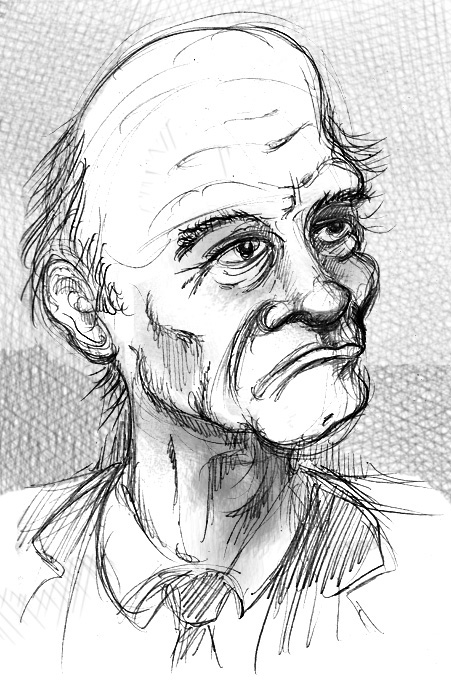
Young Peter Boyle joined a monastery, in his hometown of Philadelphia, just after high school. After losing his religious calling, he became a cameraman at a local TV station and later look acting lessons from Tony Award-winning actress Uta Hagen in New York City.
He was cast in the title role of the violent and controversial 1969 film Joe, playing a murderous bigot. Liberal-minded Peter was appalled by the audience’s supportive reaction to the character and vowed never again to appear in a movie in which violence is glorified. A man of his word, he turned down the role of Popeye Doyle in The French Connection, a role for which Gene Hackman earned the Academy Award.
Peter appeared in mainly dramas playing gruff types, usually cops or gangsters. In 1974, he took an unexpected, yet hysterical, turn as The Monster in Mel Brooks’ gothic horror parody Young Frankenstein. On the set of Young Frankenstein, Peter met Rolling Stone reporter Loraine Alterman. He was in full monster make-up when he asked her for a date. Through Loraine’s friend Yoko Ono, Peter developed a lifelong friendship with John Lennon. John served as best man at Peter’s and Loraine’s wedding. Peter’s career was all over the map through the 80s and 90s, starring in dramas, comedies and even science fiction. In 1990, Peter suffered a stoke that left him immobile and unable to speak. After a long and difficult recovery period, Peter returned to acting and won an Emmy for a guest appearance in the popular X-Files series in 1996. This led to his signature role as perennial crank Frank Barone on the sitcom Everybody Loves Raymond. Peter was nominated for an Emmy seven consecutive times during the run of the series, but never won. He lost three consecutive times to co-star Brad Garrett. In 1999, Peter suffered a heart attack on the set of the show. Again, he regained his health and returned to acting. He starred opposite Billy Bob Thornton in the gritty Monster’s Ball, as well as continuing to play Ray Romano’s father on television.
Peter appeared in all three Santa Clause films with Tim Allen, the last bearing a dedication to his memory. Peter passed away from heart disease in 2006. His friend, Bruce Springsteen dedicated a performance of the song “Meeting Across the River” to Peter, on what would have been the actor’s 72nd birthday.
Comments
IF: resolution
The first Illustration Friday challenge word of 2011 is, fittingly, “resolutions”.
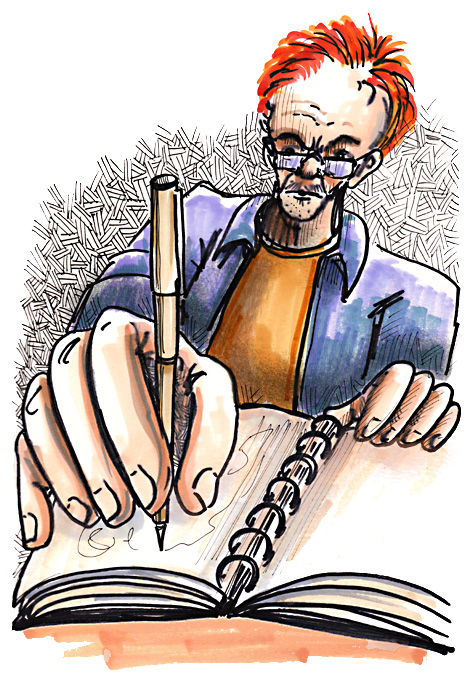
I usually don’t make New Year’s Resolutions, but this year I thought I would attempt to do one million drawings. That sounded pretty cool. So, I did the math (with a calculator I’m an artist, after all). In order for me to fulfill my goal of one million drawings in 2011, I would have to create two thousand seven hundred forty every day. This would allow me to skip a few here and there over the course of a year, in case there are some days that I am not feeling particularly creative. At that rate, I will be on course to create one million one hundred drawings. Today, however, is January third and, so far, I have done three illustrations in 2011. I am currently eight thousand two hundred seventeen drawings behind schedule.
My other resolution was to try to be nicer to people, but fuck that.
Comments
from my sketchbook: william holden
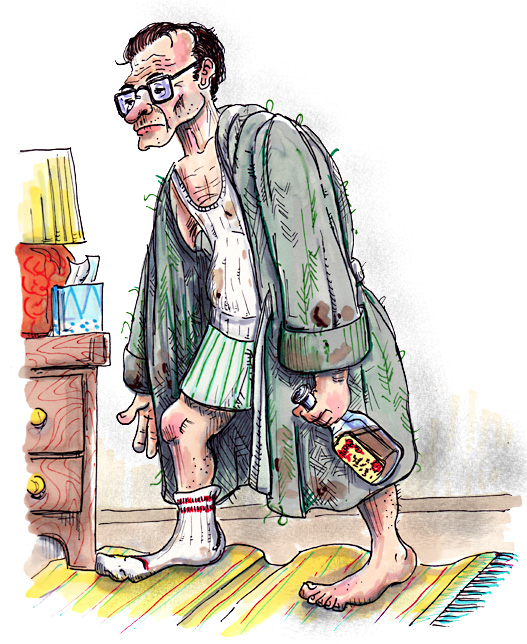
In 1939, ruggedly handsome, gravelly-voiced William Holden had the starring role in Golden Boy opposite Barbara Stanwyck. He followed that with minor, forgettable parts through the 1940s until his breakout role as Joe Gillis in Billy Wilder’s classic the hauntingly memorable Sunset Boulevard in 1950. William received his first of three Best Actor Oscar nominations for the part and his career took off. Perfecting the part of “everyman” leading man, William won the Academy Award in 1953 for another Billy Wilder vehicle, Stalag 17.
William was one of the top box office draws of the 50s, appearing in Picnic, Bridge on the River Kwai, the controversial The Moon is Blue and opposite Humphrey Bogart and Audrey Hepburn in Sabrina. He started a romantic relationship with Hepburn during filming until she broke it off when William revealed he had undergone a vasectomy.
By the 1960s, William’s films had less commercial success, but due to contractual obligations he was forced to make them. In 1964, he was paired again with a now-married Audrey Hepburn in Paris When It Sizzles. He tried to rekindle a romance, but was rebuffed. That uncomfortable situation coupled with William’s increasing alcohol consumption had disastrous effects of the film’s production. William’s advanced alcoholism began to take its toll. In 1966, he was convicted of vehicular manslaughter in Italy after a car accident in which he killed the other driver.
In 1974, William Holden, now beginning to show his age, joined the all-star cast of the disaster film The Towering Inferno and two years later he earned his third Oscar nomination for a role more suited to the acting talents of his heyday as Max Schumacher in the acidly-satiric Network. He lost to costar Peter Finch, who received the first posthumous performance Oscar.
In the early 70s, William began a relationship with Stefanie Powers, an actress 24 years his junior and famous for the TV series Hart to Hart. She was very aware of his drinking problem.
In the early 80s, William was a part owner of an apartment building in Santa Monica, California, and he lived in a unit on the fourth floor. He was known to be a very private person, sometimes not emerging from his apartment for days. In November 1981, the building manager became concerned after not seeing William for several days. He used his passkey to enter William’s apartment. Upon entering the bedroom, he found William’s body partly clad in a bathrobe and lying in a pool of blood. There was a large gash in William’s forehead and he was surrounded by bloody tissues and a rumpled throw rug. A wooden nightstand was obviously moved from its original position and the far corner of the square top was jammed about three inches into the wall. An empty bottle of vodka was found in a trash can and several beer and liquor bottles were found in the kitchen. A subsequent autopsy concluded that a drunken William (with a blood alcohol level of .22) had tripped on the rug and smacked his head on the table, resulting in the wound. He hit the table so hard, he drove it into the wall. Not realizing the severity of his injury, he attempted to stop the bleeding with Kleenex until he passed out from loss of blood. When he was found, he had been dead for almost four days. There was a working telephone just inches from his body. William Holden was 63.
Comments
from my sketchbook: banjo pig 4

Here is the fourth in a series of pigs playing the banjo.
(Inspired by the Dueling Banjo Pigs website.)
Comments
IF: winter
This week’s Illustration Friday word is “winter”.
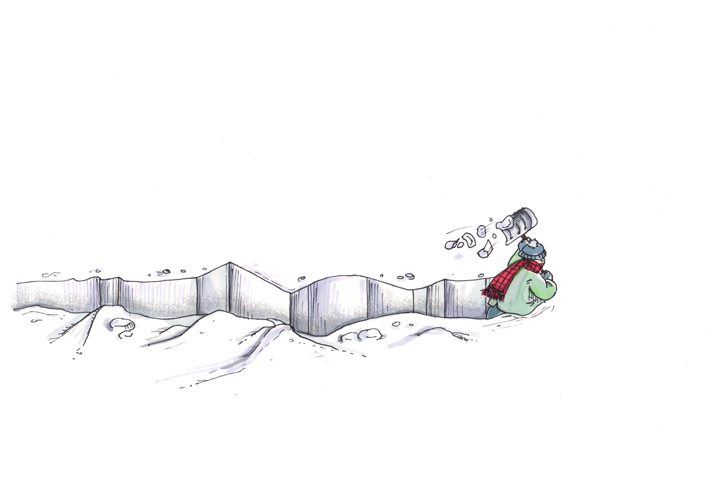
Winter is nature’s way of saying, “Up yours.”
Here is an earlier blog post that sums up my feelings about winter.
Click HERE to download a version of this illustration to use as wallpaper for your computer. (Click the link, then right-click and “Save picture as…”)
Comments
from my sketchbook: orson welles
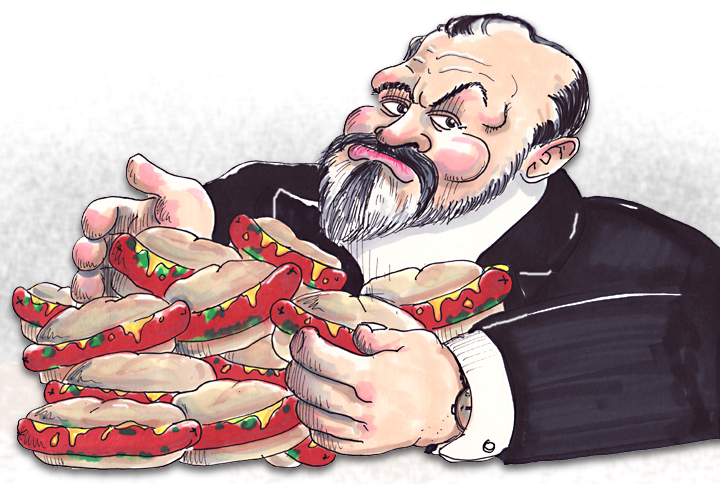
Orson Welles lived a life filled with accomplishment.
At the age of 20, he presented a version of Shakespeare’s Macbeth, reworked in a Haitian setting with the three witches as voodoo priestesses. The production was highly praised for its originality.
In 1938, he gained international fame when he frightened the entire country with his radio broadcast of War of the Worlds.
At the age of 25, he co-wrote, produced, directed, and performed the lead role in the magnificent Citizen Kane, one of the greatest films of all time. The movie earned nine Oscar nominations and won the award for Best Screenplay for 1942.
He was voted by one of the greatest American actors of all time by the American Film Institute, based on his forty-six years in Hollywood as a true auteur.
He had a torrid affair with Latin bombshell Delores Del Rio and later married screen siren Rita Hayworth.
Welles lent his booming baritone voice as narrator to countless films, in addition to documentaries and commercials.
He was a frequent and popular guest on talk shows, often discussing his rich history in films, as well as his varied interests in magic, forgery, and the supernatural. In 1985, he gave his last interview on The Merv Griffin Show, two hours before he died of heart failure.
But, Welles’ greatest accomplishment is one that still holds today. One that is seemingly impossible to surpass. Welles holds the unmatched record for eating the most hot dogs in one sitting at renowned Los Angeles hot dog stand, Pink’s. He ate 18.

Comments
from my sketchbook: donna reed
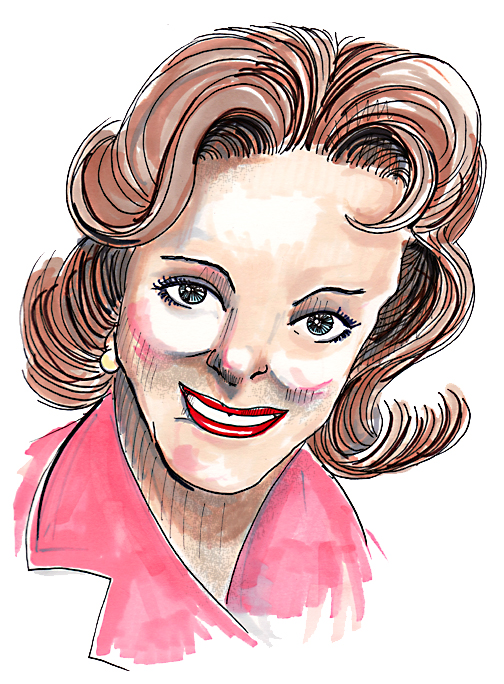
Donna Reed’s career ran the full spectrum from her humble beginnings opposite Mickey Rooney in The Courtship of Andy Hardy to her popularity as a pin-up girl during World War II to her Academy Award-winning performance as prostitute Lorene Burke in 1953’s From Here to Eternity.
Network executives must have been focusing on her role as Mary Bailey in the beloved Frank Capra holiday classic It’s a Wonderful Life when they offered her the role of perfect housewife Donna Stone on a new ABC sitcom (unless they just dug her as the From Here to Eternity hooker). Donna vacuumed and washed dishes in pearls and high heels for eight seasons in The Donna Reed Show. Her character is still perceived as the model for the All-American subservient homemaker.
When actress Barbara Bel Geddes decided to step down as Ewing family matriarch “Miss Ellie” on the popular nighttime drama Dallas, Donna was recruited to fill the part. After one season Bel Geddes returned and Donna was unceremoniously fired. She sued the production company for breach of contract and settled out-of-court for over a million dollars. Shortly after, Donna was diagnosed with terminal pancreatic cancer and passed away just shy of her 65th birthday in 1986.
Donna experienced an unusual twist of fate early in her personal life. In 1945, Donna flew to Mexico to obtain a divorce from her first husband, Hollywood make-up man Bill Tuttle. Returning home, Donna boarded a plane in El Paso, Texas headed for Los Angeles. Just before take off, Donna was bumped from the flight to make room for a military officer. On its approach to Burbank’s Lockheed Air Terminal, the plane crashed, killing everyone on board.
Comments
DCS: stanley adams

Stanley Adams was a television staple for three decades, appearing in numerous roles in countless series. He was cast in parts as diverse as policemen and bartenders to con men and aliens. Among his more than a hundred guest spots, he played Otis the drunk’s equally-soused brother in an episode of The Andy Griffith Show, a time traveller in The Twilight Zone, a head-hunting savage in the final episode of Gilligan’s Island and Tybo the Carrot Man in a memorable, yet typically hokey, episode of Lost in Space. Possibly, his most famous TV appearance was that of Cyrano Jones in “The Trouble with Tribbles” episode of the original Star Trek series. Stanley was a scriptwriter for several television series, too, including “The Mark of Gideon” episode of Star Trek.
Stanley also enjoyed a successful career playing assorted small character roles in over fifty theatrical films. He was the wealthy Rusty Trawler in Breakfast at Tiffany’s and the Hispanic cafe owner opposite Oscar-winner Sidney Poitier in Lilies of the Field. Stanley also had an uncredited part as Lieutenant Harding in Hitchcock’s North by Northwest.
Success as an actor and writer was obviously not enough for Stanley. He died from a self-inflicted gunshot in 1977.