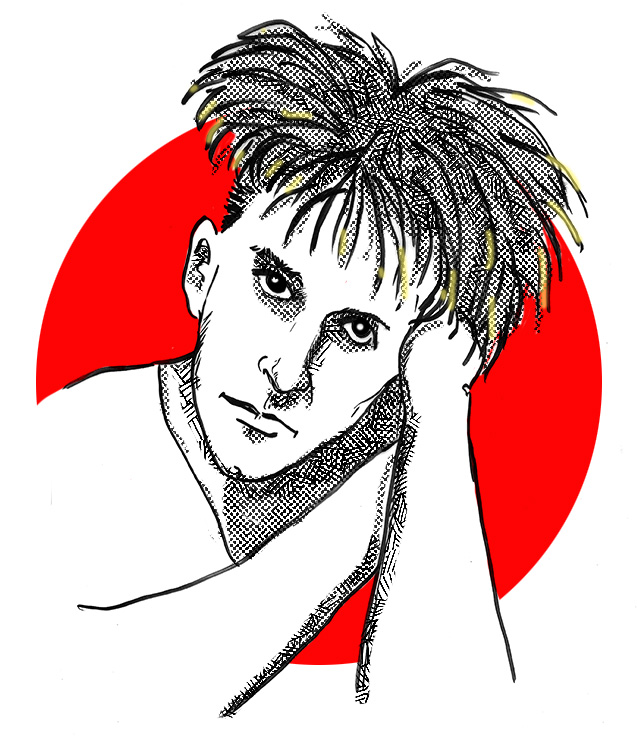
DCS: carolyn bryant
In 1955, Carolyn Bryant made up a story that resulted in a 14 year-old young man being brutally beaten and lynched.
She died on April 25, 2023. She hung on to her made-up story for sixty-eight years.
With no remorse.
Comments
inktober52: grim
Comments
DCS: herbert zipper
Shortly after the 1938 annexation of Austria by the Nazis, Herbert Zipper and two of his brothers were sent to Dachau concentration camp. Despite the horribly adverse conditions, Herbert volunteered for demeaning jobs, where he could steal wood and other materials to make musical instruments for himself and his fellow prisoners. He assembled a small, secret orchestra that performed for the other inmates. Herbert composed “Dachau Song,” which was performed in secret and eventually would find its way to other camps.
Through his father’s persistence, Herbert was released in 1939. He was offered the position of conductor of the Manila Symphony Orchestra in the Philippines, which he accepted. He was imprisoned once again when the Japanese army invaded the Philippines. He was released after four months. After his release, he worked secretly for the Allies, transmitting shipping information by radio.
In 1946, Herbert emigrated to the United States. He became an advocate for music education, teaching at several respected schools in Chicago and in Southern California. He remained active until his death in 1997 at age 92.
Comments
inktober52: prowl
Comments
DCS: anthony newley and connie kreski
Anthony Newley was a talented, versatile actor, singer and songwriter. As a teenager, he was the star of a popular British film serial. This part led to a featured role in a 1946 film production of Oliver Twist, placing him as “The Artful Dodger” alongside Alec Guinness as “Fagin.” Later, he topped the British charts with recordings of the Lloyd Price tune “Personality” and “Why,” originally a hit for Frankie Avalon. He earned multiple Tony nominations for the musical Stop the World — I Want to Get Off. Anthony co-wrote the libretto, the songs and starred in the show on the London Stage, as well as its Broadway run. He won a Grammy in 1963 for “What Kind of Fool Am I,” the song he introduced as the show’s finale. He followed his success with another favored musical — The Roar of the Greasepaint — The Smell of the Crowd. He appeared in dozens of movies, including a co-starring part in Dr. Doolittle. In addition he co-wrote the title song for the James Bond film Goldfinger and all the songs for the beloved Willy Wonka and the Chocolate Factory.
In 1970, Universal Pictures sunk half a million dollars into new musical from the golden pen of wunderkind Anthony Newley. The film — Can Heironymus Merkin Ever Forget Mercy Humppe and Find True Happiness? — was a self-indulgent, psychedelic mish-mash that proved to be a financial and critical failure for the studio. With Anthony as producer, director, music director, composer and star, he led the cast down a confusing road of fantasy-charged, sexually-rampant, nonsensical scenarios for a bewildering 107 minutes. Due to its content, the movie was given an “X” rating and a lot of newspapers refused to carry its advertising for that reason.
In the very loose autobiographical film, Anthony plays the titular “Heironymus Merkin,” a respected musical performer approaching middle age and questioning his relevance as presented in a series of erotic production numbers. He cast his his then-wife Joan Collins as the suggestively-named “Polyester Poontang,” Milton Berle as a dapper devil-like character called “Goodtime Eddie Filth” and George Jessel as an unnamed messenger from Heaven. Rounding out the cast was 22-year old Connie Kreski, as the “Mercy Humppe” mentioned in the film’s elongated title. Hand-picked by Anthony on recommendation by his pal Hugh Hefner, Connie was making her film debut. Her only previous “before the camera” experience was posing nude in Playboy, earning the title of 1969’s “Playmate of the Year.” The film was fraught with innuendo and overt symbolism, weird sets and outlandish costumes and featured Anthony taking on the dual role as main character and the film’s on-screen director, depicted in harlequin makeup and often breaking the “fourth wall.” Joan Collins noted in her 1978 memoir that this film was a major factor in her divorce from Anthony Newley.
Despite the film’s miserable performance, Anthony remained active. He was often seen on television, variety shows, special programming, night clubs and even an appearance on the popular game show Hollywood Squares. He continued to write songs and ideas for musicals. He was working on a musical take on Richard III when he died of renal cancer in 1999 at the age of 67.
Connie Kreski enjoyed a modestly successful acting career, with roles in a few films and episodic television. She was close friends with actress Sharon Tate and was devastated by her brutal murder. Connie wrote a lovely heartfelt memorial piece about Tate for the Detroit Free Press. Connie passed away in 1995 from a previously undetected blockage in her carotid artery. She was 48 years old.
Comments
inktober52: tears

Comments
DCS: john glascock

While on tour in 1974 with his band Carmen, bassist John Glascock met charismatic Jethro Tull front man Ian Anderson. Carmen opened a few shows for Tull on their War Child tour and John Glascock was beside himself. He was a big fan of the band and meeting Anderson and his crew was like meeting royalty.
Fan favorite bassist Jeffrey Hammond left Jethro Tull just after the band toured in support of Minstrel in the Gallery. John was recruited to join Tull as Hammond’s replacement. It was a dream come true. He played on their 1976 concept album Too Old to Rock and Roll (Too Young to Die). He also provided harmony vocal, something that was missing on all previous Jethro Tull releases.
John contributed to Songs from the Wood, Heavy Horses and several tracks on Stormwatch. It was during the promotional tour for Heavy Horses that John’s health became an issue. A known defect in a heart valve was aggravated by John’s aggressive “party” lifestyle. He was a heavy drinker and a heavy user of marijuana. A doctor’s diagnosis was ignored, despite a warning that an unrelated infection in an abscessed tooth could be detrimental.
Three years to the day of his debut with Jethro Tull, John Glascock played his last show in May 1979. Later that year, he passed away from complications attributed to the infection. John was 28 years old. After Ian Anderson broke the sad news to his bandmates, John’s long-time friend, drummer Barriemore Barlow, announced his plans to leave the band.
Stormwatch proved to be the final Jethro Tull album to feature the so-called “classic” line-up. Anderson fired the entire roster, save for guitarist Martin Barre. The bass parts that were scheduled to be played by John Glascock were covered by Anderson himself.
Comments
inktober52: giant

Comments
DCS: millicent patrick
Mildred Rossi was born in El Paso, Texas, but moved with her family to San Francisco when her father was named the construction manager of San Simeon, the proposed mansion and homestead of publisher William Randolph Hearst. Camille Rossi, Mildred’s father, was working under Julia Morgan, the first female architect licensed in California. Morgan was an obvious and strong inspiration to young Mildred. Another strong female figure in Mildred’s life was Hearst’s wife Millicent. During the course of their working relationship, Julia Morgan and Camille Rossi butt heads, causing Morgan to have Rossi removed from the on-going project. The Rossi family moved to Glendale, California. Mildred, now a budding artist, took her talents to the Chouniard Art Institute in Los Angeles.
24-year old Mildred got a job at the Walt Disney Studios as a member of the all-female ink-and-paint department. Within a year, she was moved to the Animation department, becoming one of the first female animators. During her brief time with Disney, she animated the character of “Chernabog” in the 1940 classic Fantasia. She also worked on Dumbo before her departure in 1941.
Taking the name “Millicent” (an homage to Millicent Hearst), she began working as a promotional model, thanks to her striking good looks. A chance meeting with an agent led her to a job at Universal Studios. Here, she put her artistic talents to work. Under the tutelage of Bud Westmore, head of Universal’s Make-Up and Special Effects department, Millicent created make-up designs for the pirate swashbuckler Against All Flags, the drama Sign of the Pagan and the comedy Abbott & Costello Meet Dr. Jekyll and Mr. Hyde, as well as designing the iconic Metaluna mutant for the sci-fi classic This Island Earth. In 1953, Millicent created and designed the Gill Man featured in The Creature from the Black Lagoon. In the early 1950s, it was unheard-of for a woman to have such responsibility and recognition. So, Bud Westmore took full credit for the Creature design, citing Millicent’s contributions as merely “assistance.” After a promotional tour for the film, Millicent was released from her Universal contract at Westmore’s insistence. He was jealous of her talents. Millicent never worked in a “behind-the-scenes” capacity again, concentrating on small, on-screen roles instead. In the 70s, Forrest Ackerman, publisher of Famous Monsters of Filmland magazine and a close friend of Millicent’s, printed a story rightfully crediting Millicent for sole creation of the Creature costume. Subsequent research and a 2019 book corroborated the story.
While working at Disney Studios, Millicent began a relationship with married Paul Fitzpatrick. When Paul’s wife took her own life, Millicent and Paul wed, only to split a few years later. Millicent, however, took the name “Patrick” as her surname. In 1950, she had a brief affair with voice actor Frank Graham, best known for his narration of Disney’s The Three Caballeros and the Bugs Bunny cartoon Baseball Bugs. After their break-up, Graham committed suicide. He was found in his garage, dead from carbon-monoxide poisoning. He was clutching a photo of Millicent. In 1963, after a series of cancellations and postponements, Millicent married her fourth husband, voice actor Lee Trent. The couple divorced after six years, but remained linked romantically for years.
In the late 1980s, Millicent was diagnosed with Parkinson’s Disease, and later, she developed breast cancer. She passed away in hospice care in February 1998 at the age of 82.