
DCS: abby dalton

Abby Dalton cut her acting teeth under the tutelage of cult director Roger Corman, mostly playing uncredited roles as tough teenage delinquents. She totally changed her on-screen image to that of the wholesome — though innocently sexy — girl-next-door. She made guest appearances on many series in the early days of television. Abby was cast as “Nurse Lt. Martha Hale,” the girlfriend of star Jackie Cooper on the series Hennesey. At the end of the fourth season, Abby’s character married Jackie’s character and the series ended. Hennesey is rarely, if ever, shown in reruns and, although I love all things television, I have never seen this show and am not at all familiar with it.
I am more familiar with Abby’s career from her numerous appearances as a panelist on game shows through the 60s and 70s. She was often featured alongside Wally Cox and Cliff Arquette’s folksy “Charlie Weaver” on the original incarnation of Hollywood Squares as well as its Saturday morning incarnation, Storybook Squares. She also enjoyed stints on The $10,000 Pyramid, Body Language, Match Game, You Don’t Say, Password and many more.
Recently, Antenna TV, the retro television network, added The Joey Bishop Show to its regular broadcast day. When I was a kid, Joey Bishop was a favorite of my parents. They saw (and raved about) his comedy act at local venues in the Philadelphia area. (Joey was born right here in the City of Brotherly Love.) In the late 60s, Joey Bishop hosted a talk show that went head-to-head with the mighty Johnny Carson. In 1969, Joey’s talk show ended with a solemn Regis Philbin (Joey’s announcer) delivering a sort-of eulogy, as though Joey had died. Joey bounced back and continued making guest appearances on other talk and variety shows, even his onetime rival Johnny Carson.
But not much was said about Joey’s foray into sitcom territory. After seeing nearly every insufferable episode of The Joey Bishop Show, I can certainly understand why. The show was a spin-off from the highly successful Danny Thomas Show (known as Make Room for Daddy in its first three seasons). Joey played a nervous, incompetent publicity agent, with the intention of making the character the basis for a series. The Joey Bishop Show premiered in September 1961 with Joey Bishop as the same character and Danny Thomas’s daughter Marlo as Joey’s sister. The show was typical sitcom fare for the time. Actually, it was subpar. The writing was uninspired and relied on many tired old situations familiar to sitcom watchers. There was plenty of mistaken identities, misconstrued directions and wacky relatives. Joey’s character was constantly exasperated and regularly disgruntled about the hand that life had dealt him. The show’s ratings were awful. The network scrambled to “fix” it. Supporting characters were dropped. Others were replaced. Still nothing worked. By the end of the first season, the entire premise was changed and the final episode was a preview of the show’s new direction. Joey’s character would be the host of a network talk show.
Season two of The Joey Bishop Show premiered in color with a new cast and premise. Joey was married. He lived in a fancy apartment building with a bumbling superintendent and a wise-cracking maid. He had a business manager. The cast included annoying former “Stooge” Joe Besser as the building super, one-trick-pony Mary Treen as Joey’s maid and Guy Marks as Joey’s manager. Guy, however, was replaced by comedian Corbett Monica after just nineteen episodes, as Joey accused the nightclub comic of deliberately trying to upstage him. The show, in my opinion, was still awful. Every episode dripped with contempt and mistrust. Joey routinely traded insults with Treen and Besser — mostly the same insults. He was irked in some way with his guest stars (with some of the top stars of the day playing themselves). The only bright spot in this formulaic mess was Abby Dalton. Abby played Joey’s wife Ellie. She was adorable. Abby served as “straight man,” setting Joey up to deliver another jaded punchline — often while modeling the latest fashions of the day. Despite the hackneyed dialog and trite jokes, Abby remained cheerful, perky and endearing.
I watched the entire run of The Joey Bishop Show, even though I hated every minute. Sure, I am a glutton for punishment and I have done this with other series I don’t enjoy. The show never gets better. All involved appear to be going through the motions for the sake of a paycheck. Joey looks unhappy and just wants out. The guest stars seem to be unsure as to how they were even booked to appear.
Except Abby Dalton. Abby was a professional. Not necessarily a superstar, but a professional.
Abby passed away in November 2020 at the age of 88.
Comments
inktober 2023: week 2
Last week, I discussed Twilight Zone, the venerable “godfather” of horror anthology television series. While not the first, it paved the way for others in the genre like Outer Limits, Thriller, Tales from the Darkside and Masters of Horror. There were others, too. Many others. Many, many others, including one with which you may not be familiar.
Week 2 of Inktober 2023 brings Friday the 13th: The Series and its star, Canadian actress Robey. Premiering in 1987 and running for three seasons in syndication, Friday the 13th: The Series had absolutely nothing to do with the wildly popular film series of a similar name. With no mention of Jason Voorhees, Camp Crystal Lake, an ominous hockey mask or a bloody machete, Friday the 13th: The Series focused on Robey’s character of “Micki Foster.” Micki inherited an antique shop after the death of her Uncle Lewis Vendredi (slyly “Friday” in French). The shop was chockful of cursed items, made so as a result of a deal Uncle Lewis had made with The Devil. After selling a number of the store’s evil wares, Robey is alerted by former magician Jack Marshak, a friend of her late uncle, to the malevolent nature of the store’s contents. Jack explains all about the shop’s items and they spend each episode of the next three seasons trying to reacquire everything they sold. Under the guidance of producer Frank Mancuso Jr. (the same guy who produced every Friday the 13th film from part 2 until part 8, the final installment released through Paramount Studios), the series told tales of horror, paying homage to its TV predecessors. Despite absolutely no connection the film series, Friday the 13th: The Series gained a devoted cult following and, honestly, it wasn’t a bad show.
After the series’ cancelation, Robey studied Shakespearean acting at Oxford University under the tutelage of respected actor Derek Jacobi. She currently is pursuing her previously-stalled recording career.
Comments
inktober52: map
Comments
DCS: sabrina
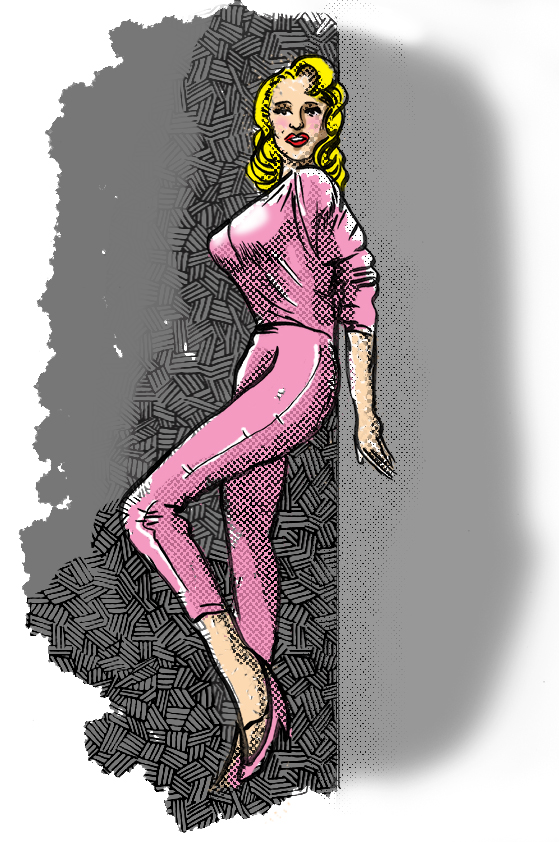
Capitalizing on the worldwide popularity of Marilyn Monroe, the former Norma Sykes shot to stardom as “Sabrina.” She, along with Diana Dors and Shirley Eaton, became England’s answer to the “blonde bombshell.” Cast as the “dumb blonde” on comedian Arthur Askey’s popular TV series Before Your Very Eyes, Sabrina became a household name in the middle 1950s. Sabrina was the BBC’s “go-to” girl and England’s male population offered no argument. Sabrina’s name was often invoked as a punchline in numerous skits on the popular Goon Show, usually with the exclamation: “By the measurements of Sabrina!”
Soon, Sabrina appeared in movies, including an equal-billing role with Alastair Sim in 1957’s Blue Murder at St. Trinian’s. in the film, Sabrina’s character sat in bed wearing a nightgown while she read a book. She had no lines of dialogue and the film’s action went on around her. She later co-starred with Troy Donahue in the western The Phantom Gunslinger. Her last film appearance was in a horror movie called The Ice House, in a role originally written for the late Jayne Mansfield.
Sabrina married a Hollywood gynecologist in 1967. The marriage lasted a decade before ending in divorce. No longer wanted by Hollywood, Sabrina lived a reclusive life, moving to Burbank and shunning family and friends. Reports of the former star living in squalor ran through the tabloids.
Sabrina had several operations to relieve the back pain that she suffered through most of her life, due, in part, to her prominent chest. In 2016, Sabrina died from blood poisoning after one of those procedures went awry. She was 80 years old. News of her death made the papers almost one year after the fact.
Comments
inktober 2023: week 1
Summer is over and October is upon is. The leaves are changing. The hot temperatures of July are yielding to cool breezes that bring a nip to the air. The sun is setting at an earlier time and everything is flavored with pumpkin spice. Well, everything has been flavored with pumpkin spice since the third week of August, but that’s a story for another blog.
October also kicks off the annual “Inktober” event for artists around the globe. Every year since 2009, the official Inktober website has been offering single word suggestions to artists to create a daily drawing throughout the month of October. I discovered Inktober in 2014 and have been participating every year every since. (I also contribute to their weekly challenge of “Inktober 52.”) However, because I am lazy (and happy to make that admission), I make up my own rules for Inktober. Come to think of it, I make up my own rules for a lot of things.
I will be posting a new, black & white drawing (and a little bit of color here and there) each week for the entire month – in addition to my participation in the regular Inktober 52. Every year, I choose a theme in keeping with the “spirit” of the Hallowe’en season. This year, my drawings will highlight a few of the many horror-related television series that have graced the small screen almost since the invention of the cathode ray tube. I’ll begin this Week 1, with the godfather of spooky anthology series – Twilight Zone and its host Rod Serling.
Although it was not the first of television’s creepy anthologies, it is arguably the best known and most beloved. Rod Serling, a respected writer himself, assembled a group of science-fiction and horror authors to write original tales or adapt existing ones in an effort to scare the crap out of Mr. and Mrs. Post-War-Fear-Everything American in the paranoid early 1960s. With a slew of now-recognizable actors like Robert Redford, Martin Landau, and the ubiquitous Burgess Meredith, Twilight Zone presented aliens, ghosts, immortals and time travelers in thought-provoking stories geared towards frightening viewers amid the safety of Leave It to Beaver and Father Knows Best. After five seasons of fighting with network censors, Rod Serling had had enough. After 156 episodes, he was finished, setting his sights on his next project – another anthology series with a more lurid, in-your face lean called Night Gallery. But, Twilight Zone wasn’t satisfied with cancellation. It lived on in reruns, as well as three more network revivals and a theatrical film.
Comments
inktober52: dream
Comments
DCS: sammy and solly drake
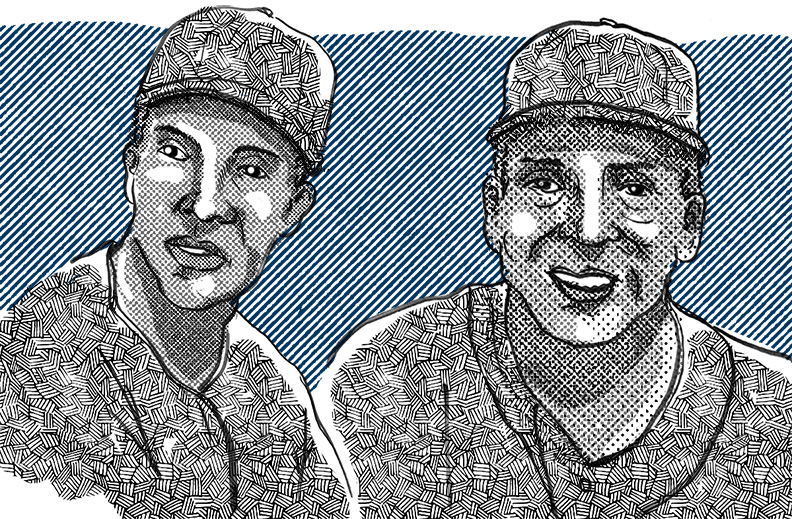
Solly Drake had dreams of becoming a professional baseball player. So did his younger brother Sammy.
As a teenager, Solly played for the Elmwood Giants, a minor league team, before he was signed to the farm system of the Chicago Cubs. In 1956, the wiry, switch-hitting outfielder made his major league debut with the Cubs, primarily used as a pinch-hitter. He bounced between the major and minor leagues for most of his career, until he announced his retirement following the 1961 baseball season.
In Solly’s final season, his brother Sammy was also signed by the Cubs. He played sporadically, mostly appearing in games as a pinch-runner. He was sent to the New York Mets, as part of the league expansion, but like his brother, Sammy moved between the minors and majors. He played in 25 games in a single season with the Mets and left baseball at the end of the 1962 season. After ending his baseball career, Sammy entered government service with a position in the United States Department of Housing and Urban Development.
Sammy and Solly Drake faced racism throughout their minor and major league baseball careers. They hold the distinction of being the first African-American brothers to play in the majors.
Sammy passed away in 2010 at the age of 75. Solly lived until he was 90, passing away in August 2021.
Comments
inktober52: harvest
Comments
DCS: agnès sorel

King Charles VII ruled France from 1422 until 1461, with his wife Queen Marie d’Anjou. The King, however, had a little something on the side. And that “little something” was Agnès Sorel.
Agnès was a 20 year-old “social climber,” who was known as Dame de beauté (Lady of Beauty). As was common at the time, Agnès was an intimate companion of the King. In fact, she became the first “official” Royal Mistress, though her duties included serving as “lady-in-waiting” to the Queen. But there was no waiting for Agnès or King Charles. Agnès bore the King four children during the course of his reign. Agnès also served as an advisor to King Charles on matters of state.
Agnès also fancied herself a fashion innovator and trend setter. She had dresses designed to her specifications. She popularized low-cut gowns for women, but hers were specially cut so one of her breasts was fully exposed. This was scandalous in the eyes of the King’s staff and other officials, especially Jean Juvénal des Ursins, the archbishop of Reims, who demanded that Agnès be forced to cover up. King Charles would have none of it. Agnès’s presence had brought the King out of a long depression, but her behavior made her many enemies.
Agnès died at the age of 28, the cause of which is debated. Some reports claimed she died of dysentery, a common malady of the time. Others say she was poisoned by enemies… another fairly common cause of death at the time.