
Hey everyone! It’s October! Summer is over. Hallowe’en is approaching! Pumpkin spice has been infiltrating all of your favorite food since July. But, October also marks the arrival of Inktober, the annual drawing exercise proposed by artist Jake Parker via his “Inktober” website. Every October, Jake and his crew posts a list of 31 “prompts” or suggestions (one for each day of the month) and challenges artists around the globe to produce a daily drawing. While I have participated in this artistic exercise for over a decade, I have never followed the rules and I have never done an Inktober drawing based on any of his daily “prompts.” (’cause I’m a loner, Dottie. A rebel!) Instead, I do a weekly drawing based on a seasonal topic of my own selection. This year, I pay tribute to a relatively short trend from the 70s (that spilled into the early 80s) — the made-for television horror movie. I loved horror movies when I was a kid. I frequently watched the Universal classics when they were shown on Saturday afternoons by a local horror show host here in Philadelphia. In the days before a zillion streaming channels and when there were just three networks from which to choose entertainment, made-for-television movies were a big deal. Someone in network programming got the great idea to make horror movies and present them alongside the usual dramatic fare that made up the majority of made-for-television movies. For the most part, these horror movies were very low budget, very poorly conceived and very poorly acted. But, my pre-teen sensibilities didn’t know any better and I loved ’em all. Over the next month, I will attempt to jog your memory.
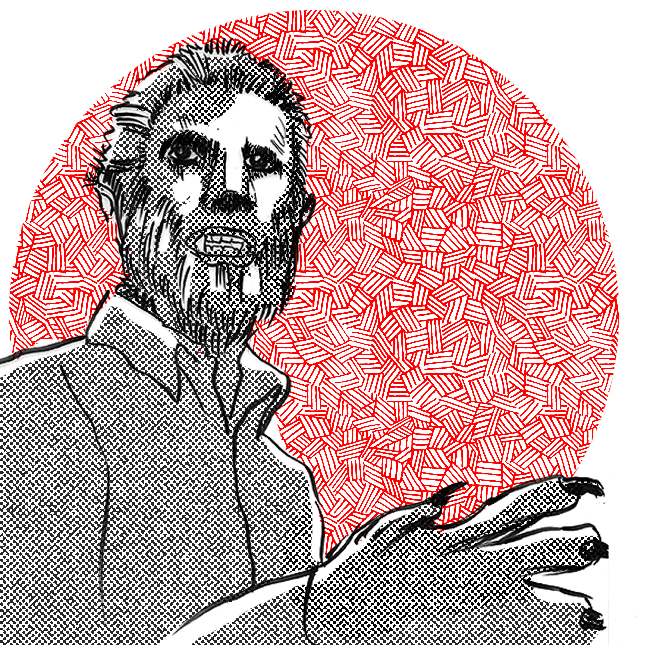
The 2026 version of Inktober (Josh Pincus-style) begins with Week One’s entry — Moon of the Wolf.
My favorite of the celebrated Universal Monsters was The Wolfman. The 1941 horror classic starred Lon Chaney Jr. as the hapless Larry Talbot, a role he reprised four more times on the big screen. Poor Larry was bitten by a werewolf and every full moon that popped up over the course of five films, he turned into a bloodthirsty werewolf himself. Although he was killed in each film, he would return and return again like a hairy Energizer bunny. The werewolf legacy proved to be enduring and has been the storyline for countless movie franchises.
In 1972, ABC jumped on the werewolf bandwagon with Moon of the Wolf. With a cast of familiar television faces like David Janssen, Barbara Rush and Geoffrey Lewis, Moon of the Wolf presented a creepy tale set in the creepy bayous of creepy Louisiana. Another familiar television actor, Bradford Dillman played the werewolf, sporting make-up that looked as though it was picked up from the Woolworth’s Halloween department. Following an often used trope, Moon of the Wolf told the tale of a mysterious canine that was terrorizing the sparsely populated bayou country. Packed with rehashed lore, predictable action and words like loup garou, Moon of the Wolf was perfect entertainment for any 11-year old horror fan… which I was.
Two years later, David Janssen would enjoy success in a role more to his suiting. He played detective Harry-O for two seasons. Barbara Rush took a recurring role in The Bionic Woman as the title character’s mother. She was later cast as the love interest of Captain Stubing in a two-part Love Boat. Bradford Dillman was a busy actor before and after Moon of the Wolf, with roles in theatrical releases as well as TV series and more made-for-television movies, though no more werewolf roles were in his future.