

DCS: david johansen

David Johansen, the front man of the seminal glam-punk band The New York Dolls, passed away in February 2025 after a five year battle with cancer, exacerbated by a fall in late 2024 in which he broke his back in two places.
Despite his raucous, exuberant, over-the-top stage persona, David was — by all accounts, — a sweet, humble and caring man. Several friends of mine have shared personal encounters with David — each one a testament to his kindness. I only met David once, very briefly. In 2006, my then-teenage son was working as an intern at a local Philadelphia radio station. This station presents an annual summer music festival and, in 2006, the reformed New York Dolls were scheduled to perform. My son’s assignment was to escort the bands from the “green room” to the stage. He led the late Sylvain Sylvain and David Johansen right past me as I leaned over from the audience side of a metal barricade. I called out my son’s name. He looked up and pointed me out, saying to David: “That’s my dad.” David halted in his tracks to pose for a quick (and memorable) photo with my son before continuing the journey to the stage.
During the band’s performance, the outdoor venue lost power. While the tech crew scrambled to restore electricity, David sat down at the edge of the stage — his long and lanky legs swinging carefree — and sang sans microphone to the delight of the crowd.
David and The Dolls created a genre of music without even knowing they were doing so. They just did what they did, never setting out to be the inspiration for future bands.
And David….. David was a good guy.
Comments
inktober52: lamp

Comments
DCS: hubert johnson

In 1959, three Detroit musicians formed a singing group called “The Blenders…” with little success. The next year, popular singer Jackie Wilson suggested the trio become a quartet with the addition of Jackie’s cousin Hubert Johnson. Hubert was accepted and the group changed their name to The Contours. Soon after, music impresario Berry Gordy signed the group to his fledgling Motown label. They recorded and release the single “Do You Love Me?” The song hit Number Three on the Billboard charts. Over the next few years, The Contours enjoyed more success as well as several more charting songs.
In 1964, The Contours left Motown and their popularity declined until they were just another forgotten singing group.
In the 80s, Hubert Johnson suffered from poor physical health as well as mental health issues. He began receiving treatment for depression. In 1981, Hubert was found dead in his Detroit home. He had ingested rat poison and shot himself in the head. He was 40.
Comments
DCS: sam theard
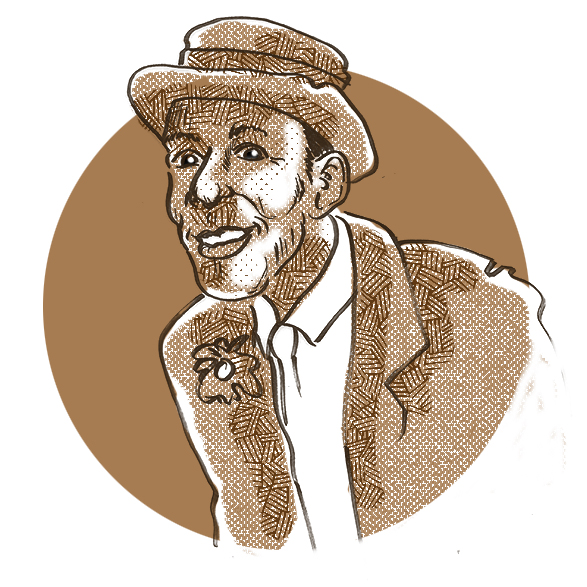
As a young man in New Orleans, Sam Theard began performing in the circus, as well as theaters and nightclubs. In 1929, accompanied by noted blues musicians Tampa Red and Cow Cow Davenport, Sam wrote and recorded “Ill Be Glad When You’re Dead, You Rascal You” under the whimsical moniker “Lovin’ Sam from Down in ‘Bam.” The song was a hit and was recorded by a number of other jazz and swing bands.
He continued to write songs, sing and record through the 30s and 40s. A number of his compositions were covered by various artist for Louis Jordan to The Grateful Dead. In the 50s, Sam wrote a song called “Rock Around The Clock” — not the Bill Haley hit, but Sam’s song did inspire that one.
Using the name “Spo-Dee-O-Dee” that he picked up on the vaudeville circuit, Sam began taking acting jobs, including guest roles on Sanford and Son and Little House on the Prairie. In 1977, with the popularity of such African-American-focused shows like The Jeffersons and Good Times, ABC approached producer Garry Marshall to develop a series to appeal specifically to African-American audiences. Marshall cast Sam (credited as “Spo-Dee-O-Dee”) in a pilot called “Walkin’ Walter.” The show centered on Sam’s character as a free-spirted ex-vaudevillian freeloading off of his ex-sister-in-law and her two children. The show never made it past the pilot stage.
Sam passed away in 1982 at the age of 78. His final film — a cameo in the dreadful sequel The Sting II — was released posthumously.
Comments
inktober52: pisces

Comments
DCS: marie van brittan brown

Registered nurse Marie Van Brittan Brown grew weary of the high crime rate in her Queens, New York neighborhood. She and her her electrical engineer husband Albert were furious at the amount of time it took for police to respond to calls. They decided to take matters into their own hands.
Marie and Albert rigged an elaborate and ingenious systems of peepholes, cameras and microphones in their home. The system had its own power supply that operated various transmitters, as well as a pushbutton alarm that silently signaled police. Their system worked so well that they applied for a patent — the first of its kind for a home security system. In December 1969, they were granted Patent Number US3482037A — three years after they filed their application.
Marie and Albert’s patent has been cited as the inspiration for numerous inventions and improvements as of 2024.
Marie passed away in 1999 at the age of 76. Her daughter Norma followed in her mother’s footsteps, becoming both a nurse and an inventor.
Comments
DCS: jimmy castor

Teenage Jimmy Castor formed the group Jimmy and the Juniors and recorded “I Promise to Remember.” The single was poorly promoted by Mercury Records, which angered the budding singer. In 1966, Jimmy and the group released “Hey Leroy, Your Mama’s Callin’ You.” It was a moderate hit.
In the 70s, Jimmy formed The Jimmy Castro bunch, a decidedly more funky version of his previous group. He hit big with the bass-heavy “Troglodyte,” peaking a Number 6 on the pop charts. A saxophone cover of Procol Harum’s “Whiter Shade of Pale” and the infectious novelty tune “The Bertha Butt Boogie” became hits in both the United States and Canada. Many of Jimmy Castor’s recording were sampled by a number of hip-hop groups, including sax hooks and bass grooves. Artists like Ice-T and Afrika Bambaataa cite Jimmy as an influence on their careers.
Jimmy died from heart failure at his home in Henderson, Nevada. He was one week shy of his 72nd birthday.
Comments
inktober52: pyramid

Comments
DCS: arturo schomburg

Arturo Schomburg, son of a Black midwife and a German immigrant to Puerto Rico, was told by a grade school teacher that Black people had no heroes, no history and no accomplishments. This infuriated the young Arturo and he devoted his life to proving his teacher wrong.
At St. Thomas College in the Virgin Islands, he studied Black literature which paved the way for a career as a teacher, writer and historian. Arturo co-founded the The Negro Society for Historical Research, accumulating a collection of thousands of books, as well as other written material, tracing and celebrating Black literature, ideas, accounts and other works from African, West Indian, and Afro-American scholars. The collection eventually became the Schomburg Center for Research in Black Culture in Harlem. He was a key figure in the Harlem Renaissance and helped spread its message and influence to African-American communities across the country. Arturo was also instrumental in the fight for Puerto Rico’s and Cuba’s independence from Spain.
Following dental surgery in 1938, Arturo fell ill and passed away in June of that year. He was 64.
His grade school teacher was wrong.